Staying Busy vs. Making Progress in Your Job Search
Where your job search time actually goes—and how to make it count
"Hey, how's the job search going??"
The friend you just ran into at the grocery store means well, but it is taking everything inside of you not to scream. Instead, you paste a smile on your face.
"Great! Staying busy! I applied to 47 jobs this week."
"Oh, awesome, have you heard back yet?"
"Not yet!"
She smiles back and moves into the cheese section with an encouraging "Keep it up, you'll definitely find something soon!"
But the harsh truth is that how you're spending your time staying busy determines if and when you'll find your next role. (And don't worry, you can handle the truth. That's why you're here.)

The Chart of Truth
We all love to think we know how we spend our time, but if the haunting specter of our screen time report has anything to say about it…we really don't. Look at how you're spending time in your job search, and you might be just as surprised as the first time you learned you spent 18 hours on Instagram.
The hours you spent doomscrolling on LinkedIn comparing your career to a random connection you met at a conference once, or getting fooled by a job that looked perfect but doesn't actually exist, add up fast.
The solution: it's time for an audit, baby, and we'll make it as simple for you as possible so you know you're spending your time on what will actually land you that next role.
Not a math person? That's okay! Before you panic and close this tab, hear us out: figuring out how much time you have to spend and how you're actually spending it can help you figure out the most impactful ways to start spending it from now on.
Start here: What's in the box?
The amount of time you have to spend depends on where you are in your life and career. (These are estimates; as with everything, your mileage may vary.)
- Full-time search: ~20-40 hours/week
- Employed search: ~5-10 hours/week
- Survival mode: Whatever you can manage
Once you've established where you fit in the hours per week category, track your current chart for one week if you're the kind of person who loves a charting activity:
| Activity Area | What this means | Examples |
|---|---|---|
| Understanding yourself | Figuring out what you offer + what the market actually needs; the overlap is your sweet spot |
|
| Planning your target | Narrowing down to specific roles + companies worth pursuing |
|
| Building your story | Explaining why you're the best person to solve their specific problem |
Focus on why and how you'll help them, not your life story. Use key areas of your experience to:
|
| Positioning for ATS/applications | Getting past the robots + ghost jobs |
|
| Networking | Building real relationships that help you understand the market |
|
| Learning + skills work | Closing gaps in what you need to know or do |
Figure out what's missing: lingo? hard skills? soft skills? Pick what's interesting AND useful for your target:
|
| Taking care of yourself | Staying functional in a market that's brutal by design |
|
Be brutally honest; that 4 hours of "research" might actually be that doomscrolling we talked about.
Numbers don't lie
Once you have the breakdown in front of you, it's time to decide if it's working for you or if you need to reallocate some of your time to other categories. For example, if you're spending 80% of your time on job boards, is that getting you the results you want? Probably not, if you've had exactly 0 responses from the 47 jobs you've applied to.
The answer isn't to quit job boards completely, but to refocus your time in areas that can bring more impact.
And what if you've gotten 5 responses? You need to understand your response rate.
If you're spending 80% of your time on job board applications:
- What's your response rate? (Divide the number of applications you've sent in by the number of conversations you're having, if you're a math person.)
- If your conversion rate is lower than you want it to be (someone doing a very broad search applying to as many relevant roles as possible will have a different baseline than someone doing very narrow, targeted applications, for example), consider shifting 10-20% to another focus, like updating your portfolio.
If you're not a math person, you can still get a ballpark on this. If you spent 20 hours applying for jobs last week but heard back from one? You might want to shift more time to another activity.
Job boards aren't evil. They just aren't the whole strategy. They're one channel, and they're better for research than spray-and-pray applications in a rapidly shifting market. Job boards are most effective combined with other activities. A heavy-hitting portfolio might be what you need to hook interviewers.
The solution: Use job boards to learn patterns — what appeals to you, what's realistic, or what skills matter — not just to apply.
How to optimize
Here are the three diagnostic questions to ask yourself.
1. Where are you stuck?
If you're not finding any good opportunities, then increase the time you're spending on activation, like networking. Reach out to old colleagues to catch up, reconnect, and offer your skills for any project they're working on (you might just uncover a hidden job market).
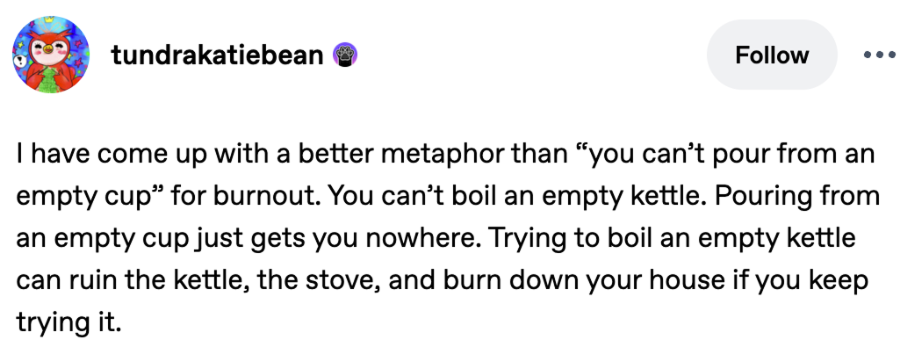
If you're feeling burnt out, you need to immediately increase the time you're spending on well-being — this is non-negotiable. Boiling an empty kettle leads only to disaster.
2. What's actually working?
The short answer: what's generating conversations? If job boards are getting you great returns, then keep using them! If networking is getting the introductions you need, find more opportunities to get face time and the connections and referrals that can come from it.
3. What feels productive but isn't?
The real trap of job searching is the activities that feel productive, but aren't. If you're spending 4 hours doomscrolling LinkedIn for "research", cap it at twenty minutes — set a timer if you have to.
Make it count: Don't try to overhaul everything; it's exhausting and impossible. Shift one hour toward the gap your audit found, and see what happens.
What this might look like
If you're the kind of person who needs a visual example, we made a stunning one for you (graphic design is our passion) of how this kind of audit might go if you were early in your job search and looking for clarity.
- 40% of your time is spent on Discovery: what do I want, what's out there
- 30% on Positioning: building your portfolio, and your pitch
- 20% on Activation: starting applications
- 10% on Sustainability: going for walks and touching grass
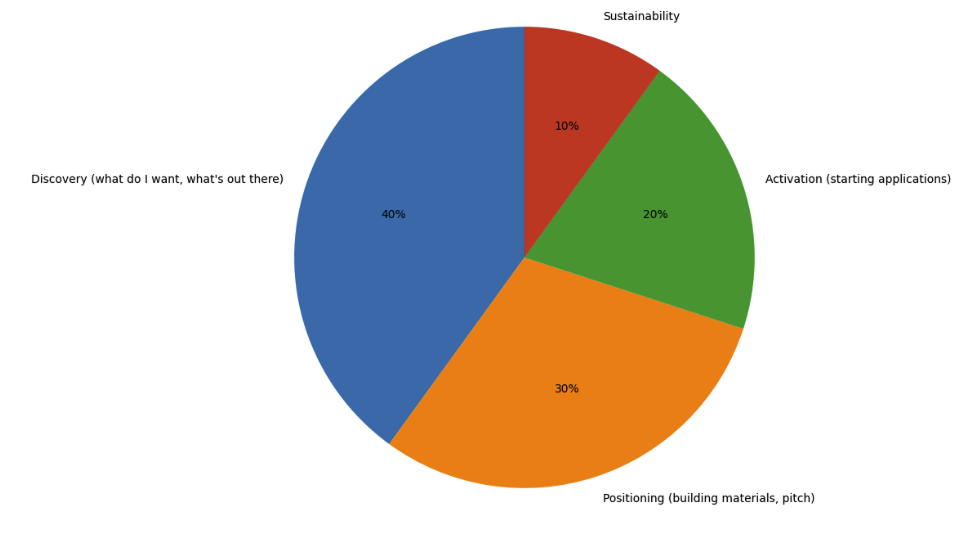
The point of this isn't to make you have nightmares about math homework from twenty years ago, but to help fit these areas of the job search together in a way that keeps your sanity (mostly) intact.
The goal is to get into rich conversations that build relationships and demonstrate to the right people that you're awesome. That requires a specific balance that shifts depending on where you are in your search and what your focus is:
- Prioritizing your well-being and setting time limits on tasks means you're mentally and emotionally equipped to do — and keep doing — the hard work of job searching.
- Research on roles and telling the story of your career mapped to those available roles means you can showcase why you're awesome and how that helps the company.
- Engaging with your network, online, and local IRL communities means you know who to talk to.
Spending hours doomscrolling job boards means you feel like you've found a productive shortcut, but it very rarely ends in an interview, let alone a job. The same way watching an hour of "Get Ready With Me" videos does not actually end with you being ready to leave the house (and now you're late for that coffee chat…oops).
Your Plan of Action
Remember that you don't have to make huge shifts if you're feeling stuck; just take an hour from applying to jobs and spend it on joining a local meetup group you're interested in. (Networking doesn't have to be 100% career focused or always mean talking to strangers around stale crackers.)
If you're just starting your search, results could take more time. If you've been at it for months and you're feeling really stuck, figure out what can help you move the needle: clarity, opportunities to make key connections, or mitigating burnout?
The takeaway: figure out what generated actual conversations in the last month, and do more of that — then track what changes. Sometimes you need to spend more time in a specific place online (LinkedIn, or on your portfolio) or in person (a coffee chat with an old boss), and sometimes it's the how you're doing outreach in those places you need to shift (rework your pitch, or add humor to your story if that's natural for you).
Take a hard look at how you're measuring success
Don't keep measuring effort in how many jobs you've applied to; measure it in terms of the conversion rate:
Old: "Applied to 30 jobs" ✓
New: "Had 2 conversations, applied to 5 strategic roles, built 1 portfolio piece, went to the gym 3x" ✓ (ROI on the gym = priceless for your sanity)
The point is that you have free will to reallocate your time. Don't just keep doing what you think you "should" be doing. Do what's having an impact.
If You Don't Love DIY Charts and Graphs
That's completely fair. We built those out as examples to help you map out your journey, but chances are you're already lost in a sea of job-searching tools. Most of them don't talk to each other in ways that are helpful for those searching. It's exhausting, and too easy for something to slip.
That's not something you're doing wrong; that's because you're a human person with the entire rest of your life to deal with outside of this one focus. If you're going to invest in a tool, look for one that makes things easier on the things that matter in a job search: CareerXray is in the early stages of building just that.
Let us know.
Pro Tip: The LinkedIn Fresh Posting Hack
LinkedIn's default filters only show jobs from the "last 24 hours," which might as well be ancient history in a competitive market. But you can hack the URL to see jobs posted in the last 4 hours, 1 hour, or even 15 minutes:
- Search for jobs in LinkedIn (if you're in the AI beta, switch back to classic search)
- Apply the "Past 24 hours" filter
- Look at your URL and find
f_TPR=r86400(that's 24 hours in seconds) - Replace it with:
- Last 4 hours:
r14400 - Last 1 hour:
r3600 - Last 15 minutes:
r900
- Last 4 hours:
- Change
sortBy=RtosortBy=DDto sort by date, not relevance (which shows promoted/old jobs first) - Bookmark this URL and check it 2-3 times a day
Why this matters: Fresh postings = fewer applicants = higher chance a human actually sees your resume. A 4-hour-old role might have 20 applicants. A 24-hour-old role? 500+.
The catch: Even with fresh roles, you still need the rest; a clear target, a strong story, and ideally a warm intro. Fresh posting + cold application is still a long shot. Fresh posting + referral from your network? Now you're playing to win.