Software Developer Jobs: What 2025 Data Reveals for 2026
Tech sector postings are down 46% since 2022. But hiring across all sectors tells a different story.
Key Takeaways (U.S. Data):
- Tech sector postings are down 46% over three years and 13% year-over-year*
- Top 10 tech employers account for only 29% of postings; most opportunities are with less obvious companies
- Among postings that specify work arrangement, 72% remain remote (but 70% of postings do not specify)
- Python, AWS, Java, and API development are among the most frequently requested skills
- Tech is only 28% of the software developer job market; 72% of postings are in other industries
- Across all industries, companies hire 40% more software developers than they post jobs for, suggesting significant hiring through referrals, internal moves, and direct recruiting
- Technical consulting, commercial banking, drug retailers/pharmacies, and telecommunications are growing faster than tech
*All year-over-year and three-year comparisons use September-November data for each year.
If You're a Software Developer, 2025 Feels Brutal
If you have been job searching lately, the numbers confirm what you are experiencing. Tech sector job postings for software developers are down 46% compared to 2022 and down 13% compared to last year.*
The roles that do exist are filling faster than before, which suggests more qualified candidates competing for fewer positions. If you have been applying and hearing nothing, you are not alone.
The chart below tracks the decline over the past three years:
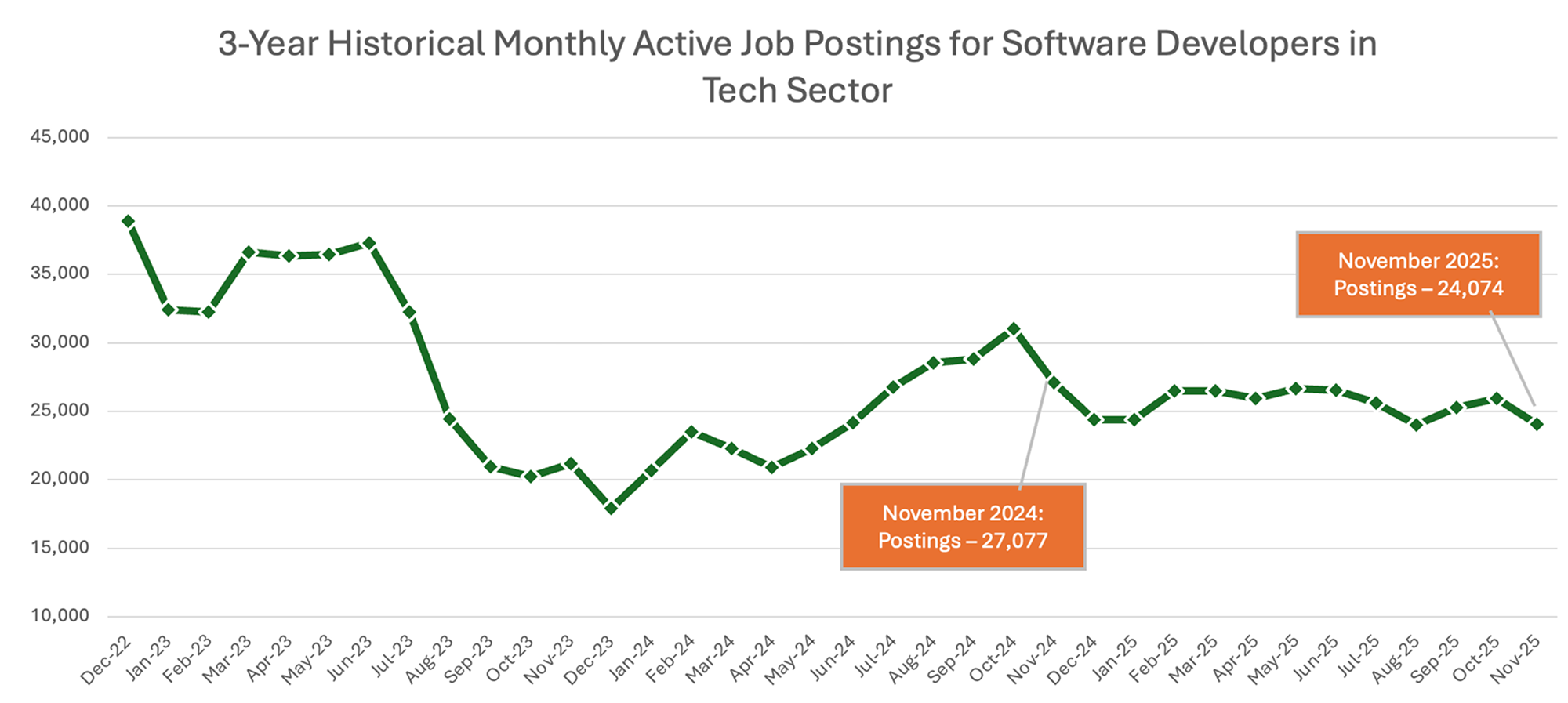
Tech sector postings for software developers from December 2022 to November 2025
Key Takeaways:
- Tech postings are down 46% over three years and 13% year-over-year
- Positions are filling 38% faster than last year, reflecting intense competition among qualified candidates
- While tech is shrinking, other sectors like technical consulting, banking, and telecommunications are growing their software developer hiring
*All comparisons in this article use September-November data for each year.
Who's Actually Hiring in Tech
If you are staying in the tech sector, understanding which companies are hiring matters. The biggest names in tech do not have the most jobs. The top 10 employers account for less than one-third of all software developer postings, meaning most opportunities are with companies you may not have on your list.
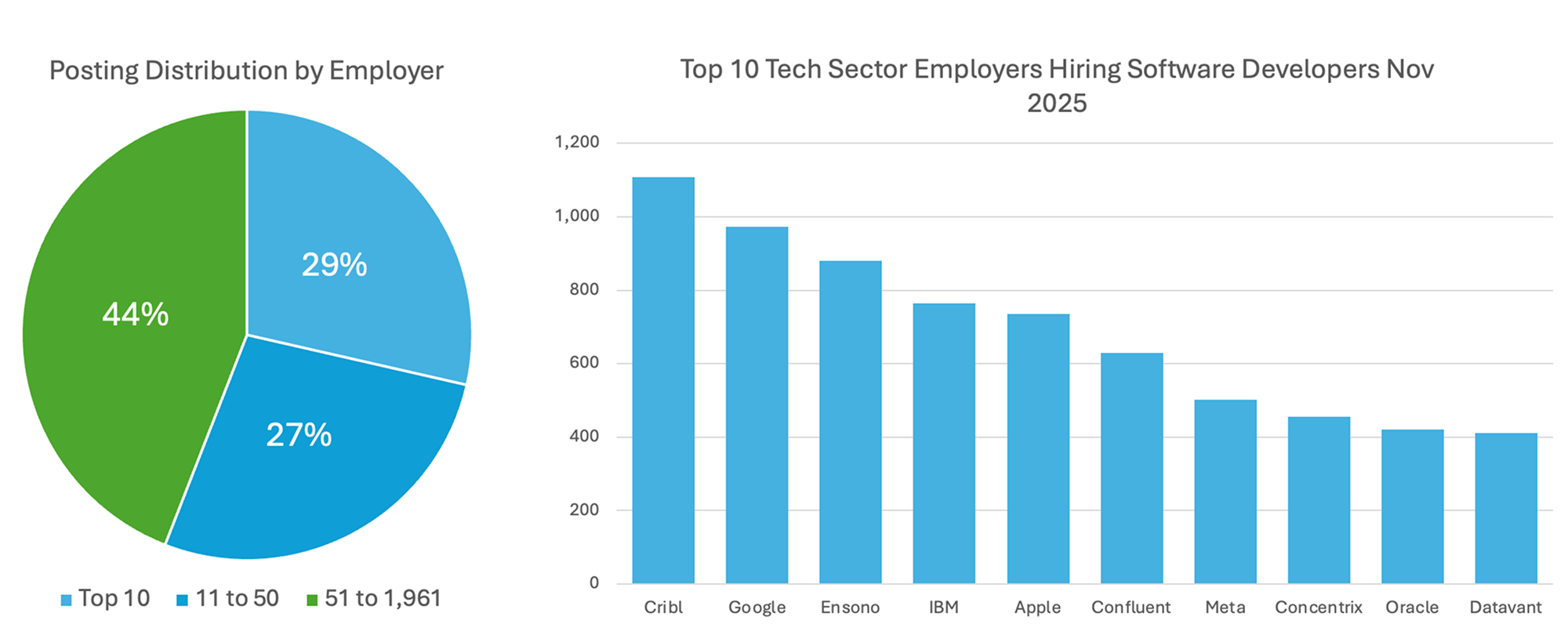
Distribution of job postings across employers and top 10 tech sector employers hiring software developers
Key Takeaways:
- Top 10 employers represent less than one-third of all job postings
- Focusing exclusively on brand-name companies means competing for a limited subset of opportunities
- The majority of positions are with mid-size and smaller tech companies
If you are wondering which companies are actually hiring, our company recommendations tool can help you discover employers beyond the usual suspects.
Where Tech Jobs Are Located
The chart below shows the top cities for software developer job postings in the tech sector as of November 2025, along with median time-to-fill data that suggests how quickly companies are hiring in each market.
Note that while these cities represent the highest concentration of postings, they account for just 24% of the total market. The remaining 76% of opportunities are distributed across hundreds of other locations.
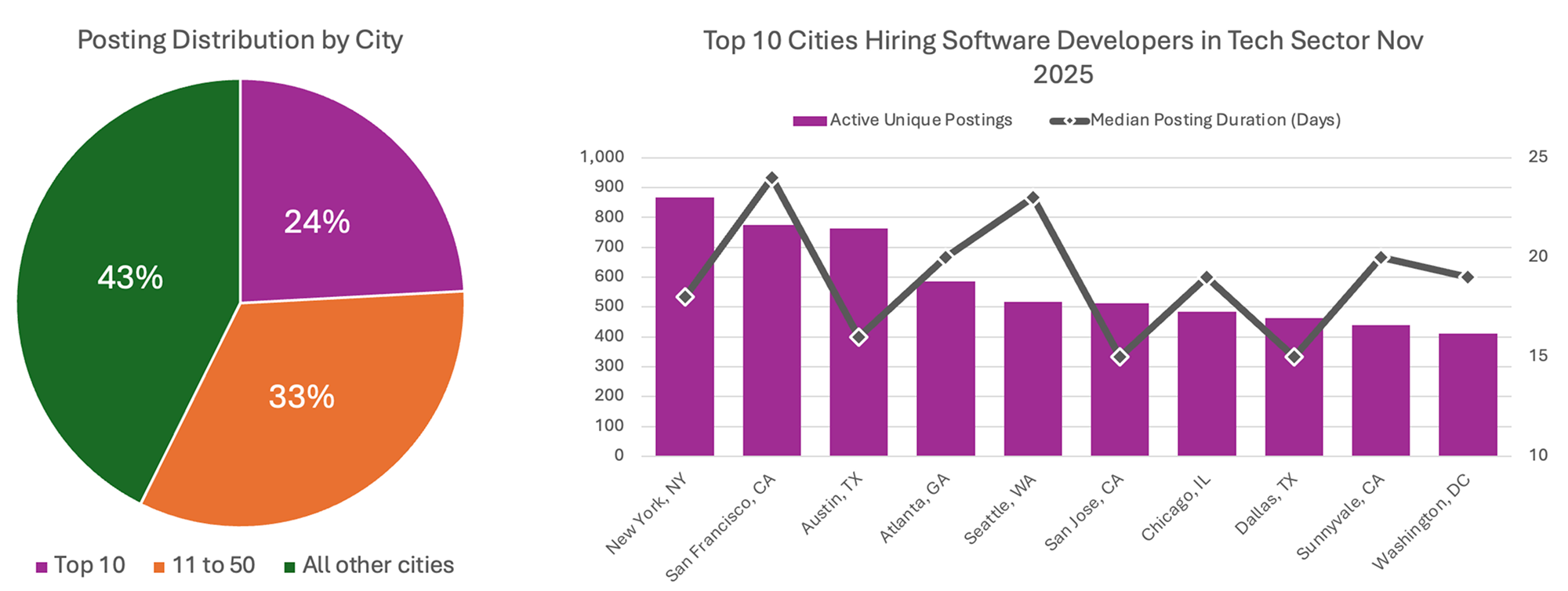
Top cities for software developer job postings with median time-to-fill data
Key Takeaways:
- Traditional tech hubs (San Francisco, New York, Seattle) still show high posting volume
- Time-to-fill varies significantly by market (15-22 days median)
- Faster fill times suggest strong candidate pools competing for each role
- Geographic distribution is broader than conventional wisdom suggests
Return to Office: What the Data Actually Shows
High-profile Return to Office (RTO) mandates have dominated tech news. But what does the actual data show?
Among the roughly 30% of job postings that specify work arrangement, remote remains dominant at 72%. Hybrid roles account for about 22%, with fully in-person positions at just 6%. The majority of postings (around 70%) do not indicate work arrangement, so take trend comparisons with caution.
What Tech Employers Ask For
The charts below show the skills most frequently mentioned in software developer job postings in the tech sector. These percentages represent how often each skill appears in job descriptions, extracted from Lightcast's database of employer listings.
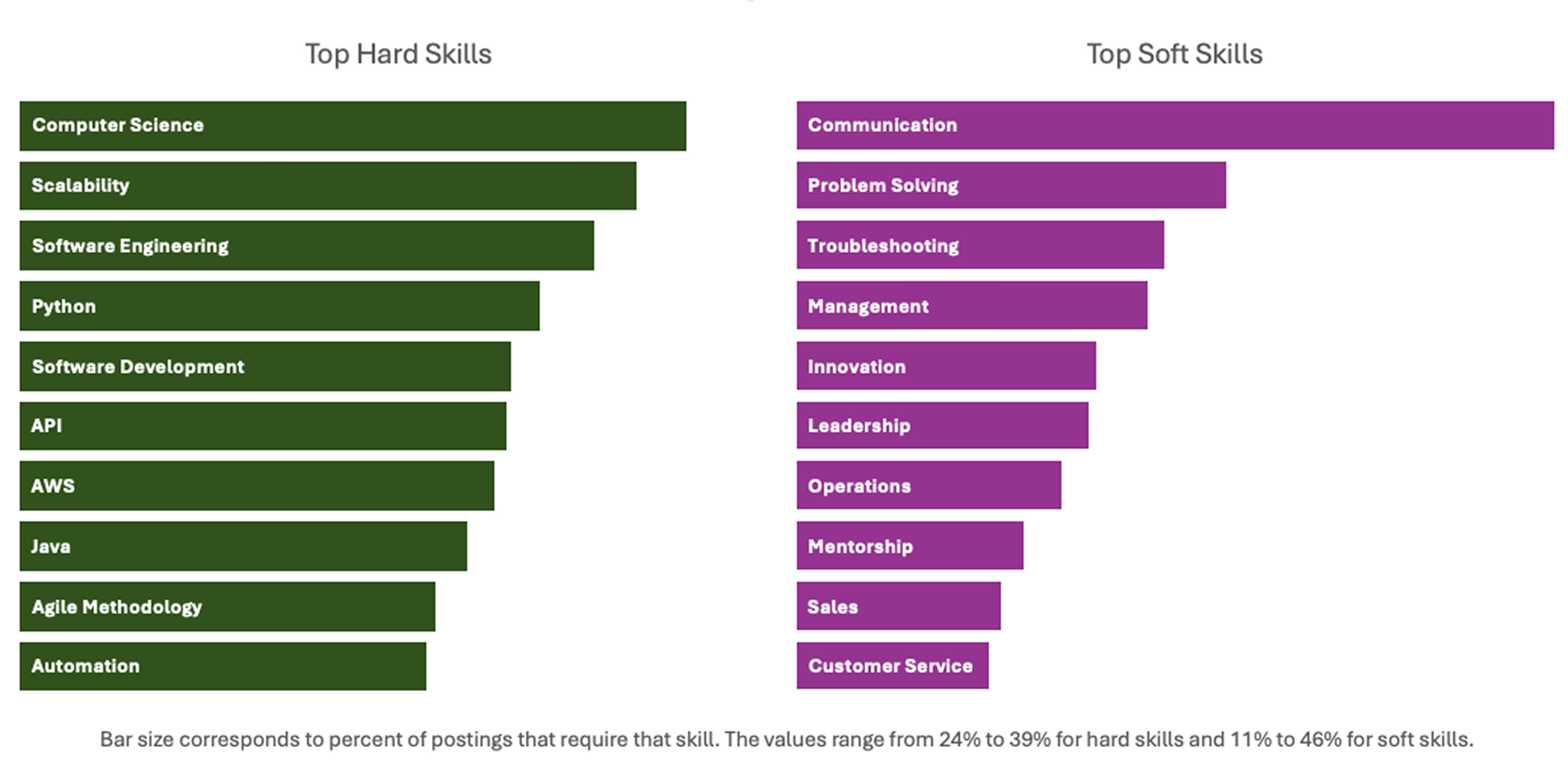
Most frequently mentioned hard skills and soft skills in software developer job postings
Key Takeaways:
- Python, Java, and SQL are among the most frequently requested programming skills
- Cloud infrastructure (AWS, Azure) and API development appear in roughly one-third of postings
- Communication skills are mentioned in nearly half of all postings, more than any individual technical skill
- Computer science fundamentals appear more frequently than trendy frameworks
Wondering which skills would open up the most opportunities for you? Our skills discovery tool can help you identify your most valuable transferable skills and find gaps to address.
If you are considering additional credentials or training, the Credential Value Index from the Burning Glass Institute can help you evaluate which programs actually deliver career outcomes.
The Bigger Picture: Hiring Beyond Job Boards
Here is where the data tells a different story.
First, some context on market size: in 2025, there were roughly 534,000 software developer job postings across all U.S. industries, with about 148,000 in the tech sector. That means tech companies account for only 28% of all software developer postings. The remaining 72% are with companies in other industries.
Second, while job postings have declined, actual hiring activity shows a more resilient pattern. The chart below compares job postings to estimated hires across all industries (not just tech). The gap is significant: companies are hiring roughly 40% more software developers than they are posting jobs for.
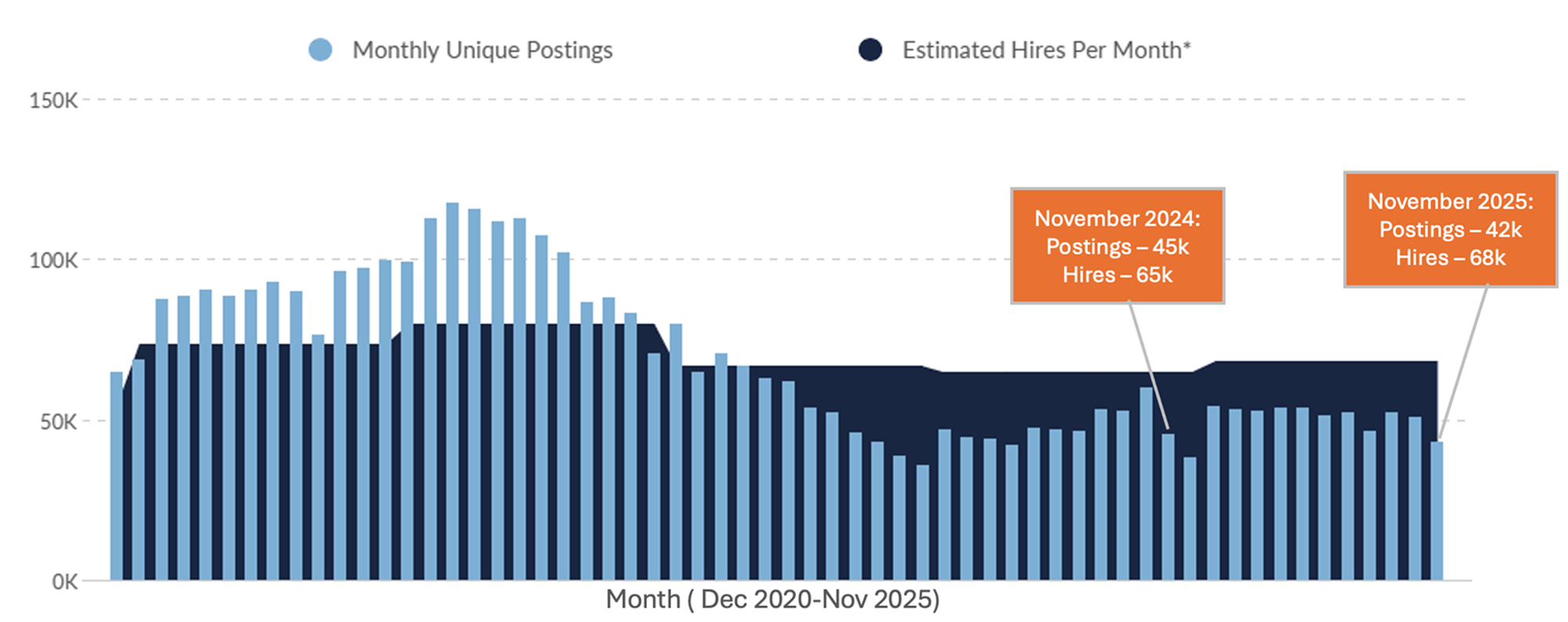
Comparison of monthly unique postings vs. estimated hires per month across all industries (Dec 2020 - Nov 2025)
Key Takeaways:
- Companies hire 40% more software developers than they post jobs for
- This gap suggests significant hiring happens through referrals, internal transfers, and direct recruiting
- Across all industries, hiring is UP 5% year-over-year even though postings are DOWN 8%
- The visible job market (job boards) does not reflect actual hiring activity
Beyond Tech: Where Hiring Is Growing
If you are open to looking beyond traditional tech companies, the data shows clear opportunities. While tech sector postings have declined, several other industries are growing their software developer hiring.
The chart below shows industries with the fastest growth in software developer job postings compared to the tech sector baseline.
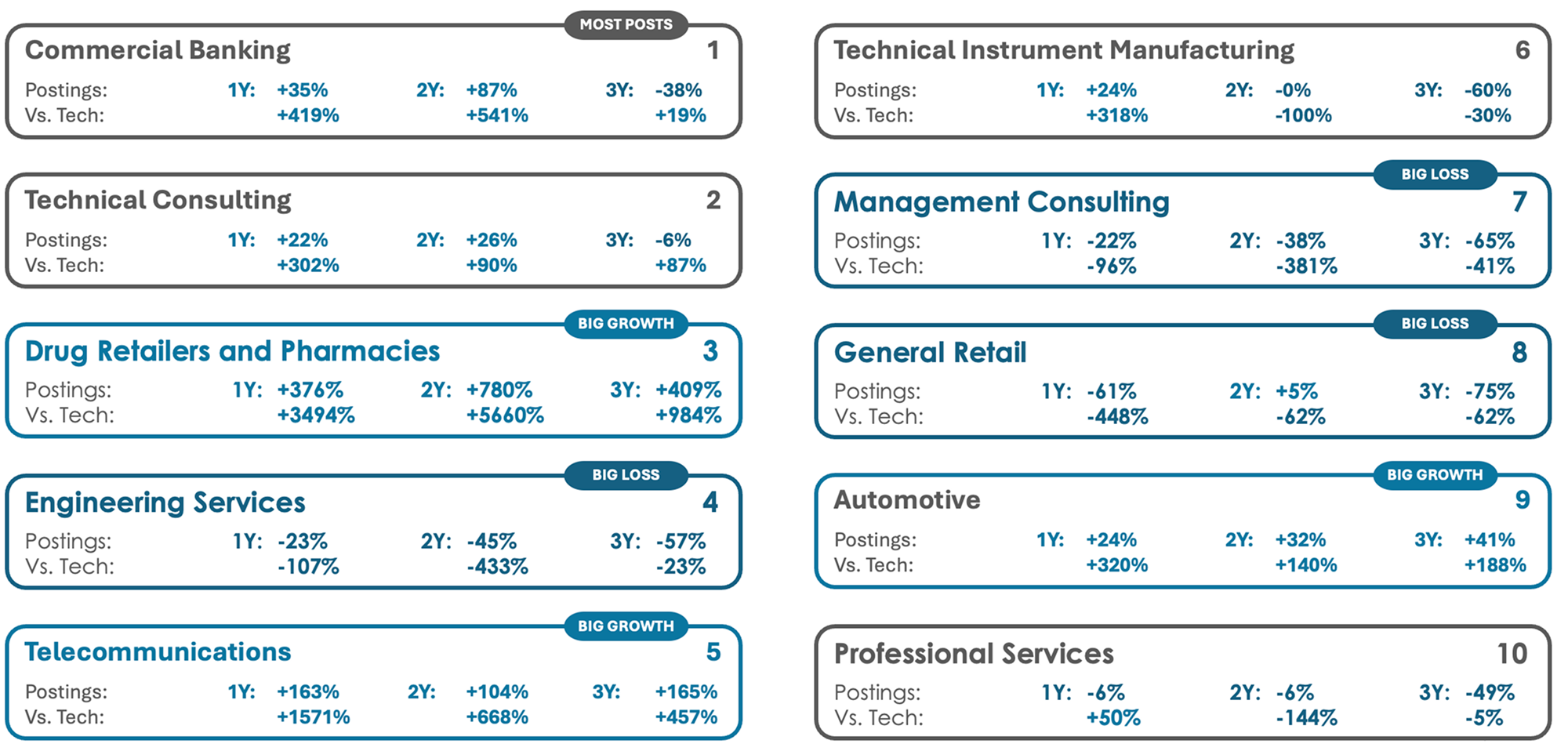
Top industries hiring software developers, with growth rates compared to tech sector
Key Takeaways:
- Technical consulting, commercial banking, drug retailers/pharmacies, and telecommunications show strong growth
- These patterns have been consistent across multiple years, not just recent months
- For developers open to industries beyond traditional tech, these sectors represent measurably different growth trajectories
Not sure which industries value your skills most? Try our skills analysis tool to see how your experience translates across different sectors.
About This Data
This analysis is based on labor market intelligence from Lightcast, covering software developer job postings and hiring activity.
Data Scope:
- Occupation: Software Developers (SOC 15-1252)
- Time Period: September-November 2022, 2023, 2024, and 2025 for year-over-year comparisons
- Sample Size: 500,000+ job postings analyzed
- Geographic Coverage: United States
Important Note on Data Scope:
The sections on companies, cities, remote work, and skills are specific to the tech sector. The sections on hires vs. postings and industry comparisons cover all industries employing software developers.
How We Define "Tech Sector":
For this analysis, "tech sector" includes companies classified under the following NAICS industry codes:
- Electronic Computer Manufacturing (334111)
- Computer Terminal and Other Computer Peripheral Equipment Manufacturing (334118)
- Software Publishers (513210)
- Media Streaming, Distribution Services, Social Networks, and Other Media Networks and Content Providers (516210)
- Computing Infrastructure Providers, Data Processing, Web Hosting, and Related Services (518210)
- Web Search Portals and All Other Information Services (519290)
- Custom Computer Programming Services (541511)
- Computer Systems Design Services (541512)
- Other Computer Related Services (541519)
- Computer Training (611420)
Hires vs. Postings:
"Hires" data represents estimated monthly hires calculated by Lightcast based on job posting duration, company hiring patterns, and other labor market signals. This is modeled data, not direct reporting from employers.
Data Limitations:
- Job posting data represents advertised positions, not all hiring activity
- Some companies hire exclusively through internal referrals or direct recruiting
- Skills data reflects what appears in job descriptions, not necessarily what leads to successful hires
- Geographic data is based on job posting location, which may differ from where work is performed (especially for remote roles)